Meal Planning
Observed patterns in daily meal planning across a cautious winter
Tobias Marsden·
The observation arrived without ceremony, somewhere between a Wednesday evening and a quiet Saturday morning: the contents of a refrigerator had begun to change, not by design, but by a slow accumulation of small decisions about what to cook and when. A year earlier, the same correspondent had shopped primarily by recipe. By February, she was shopping primarily by season. She was not sure precisely when the shift had occurred.
Harriet Caldwell did not begin this investigation with any particular framework in mind. There was no programme, no structured challenge, no list of rules. What she had, instead, was a growing awareness that the food she purchased was arriving in fragments — items selected to complete specific dishes, rarely in excess of what those dishes required, and rarely connected to anything that might be described as a broader dietary cadence.
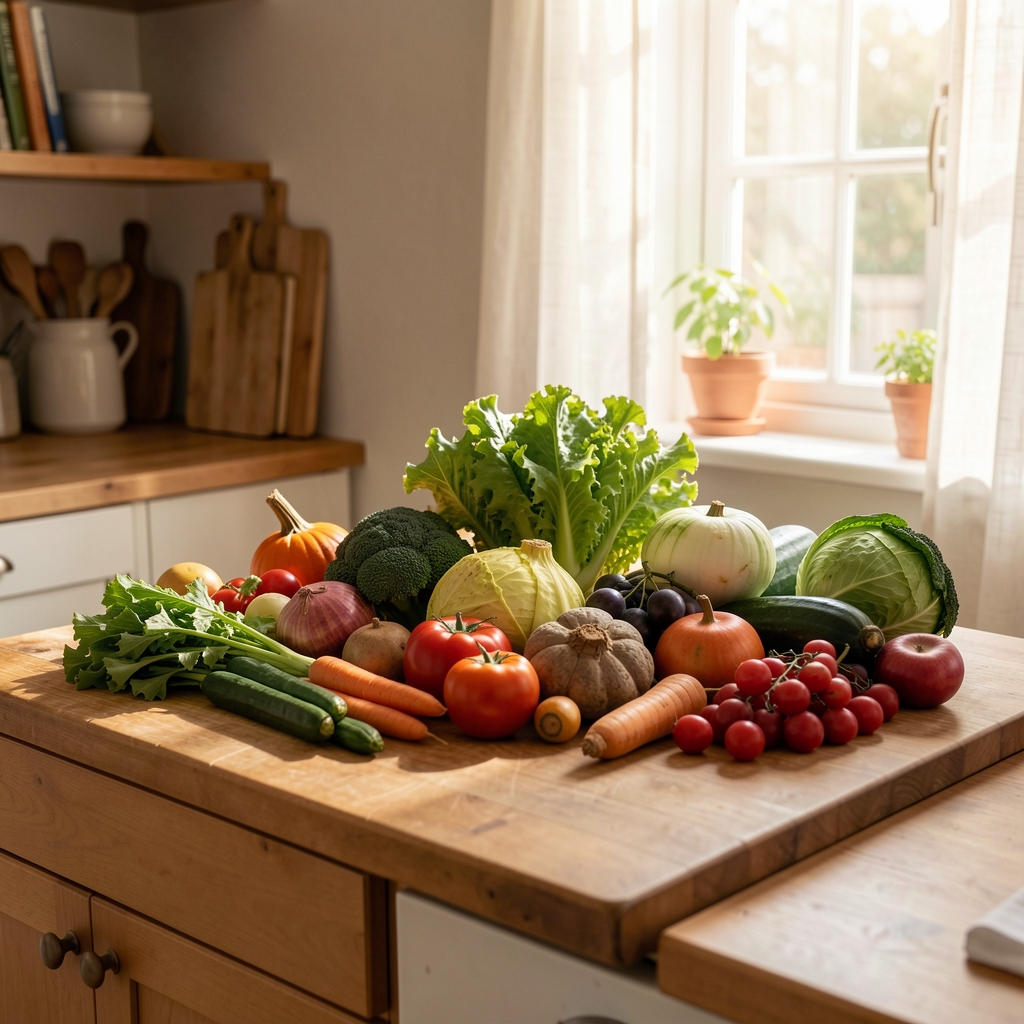
The first notable shift came in September, when the availability of courgettes and tomatoes at her local market began to narrow, replaced by the first root vegetables of autumn. Rather than compensating by sourcing summer produce from a supermarket, she found herself accommodating the shift. Butternut squash entered the kitchen. So did celeriac. Within three weeks, the household's midweek meals had, almost without announcement, become structurally different from what they had been in July.
"The seasonal rhythm did most of the planning for me," she noted in one of the entries that form the basis of this piece. "I stopped agonising over what to cook because the answer was increasingly obvious. What was in front of me, that week, became the organising principle."
In the research context of everyday nutrition, the relationship between seasonal eating and dietary variety is documented with reasonable consistency. The argument is not complicated: when a household purchases what is available in a given week rather than maintaining a fixed list, the range of vegetables and fruits consumed across a month tends to expand. This is not invariably the case, but the observational pattern recurs in a meaningful proportion of published material on the subject.
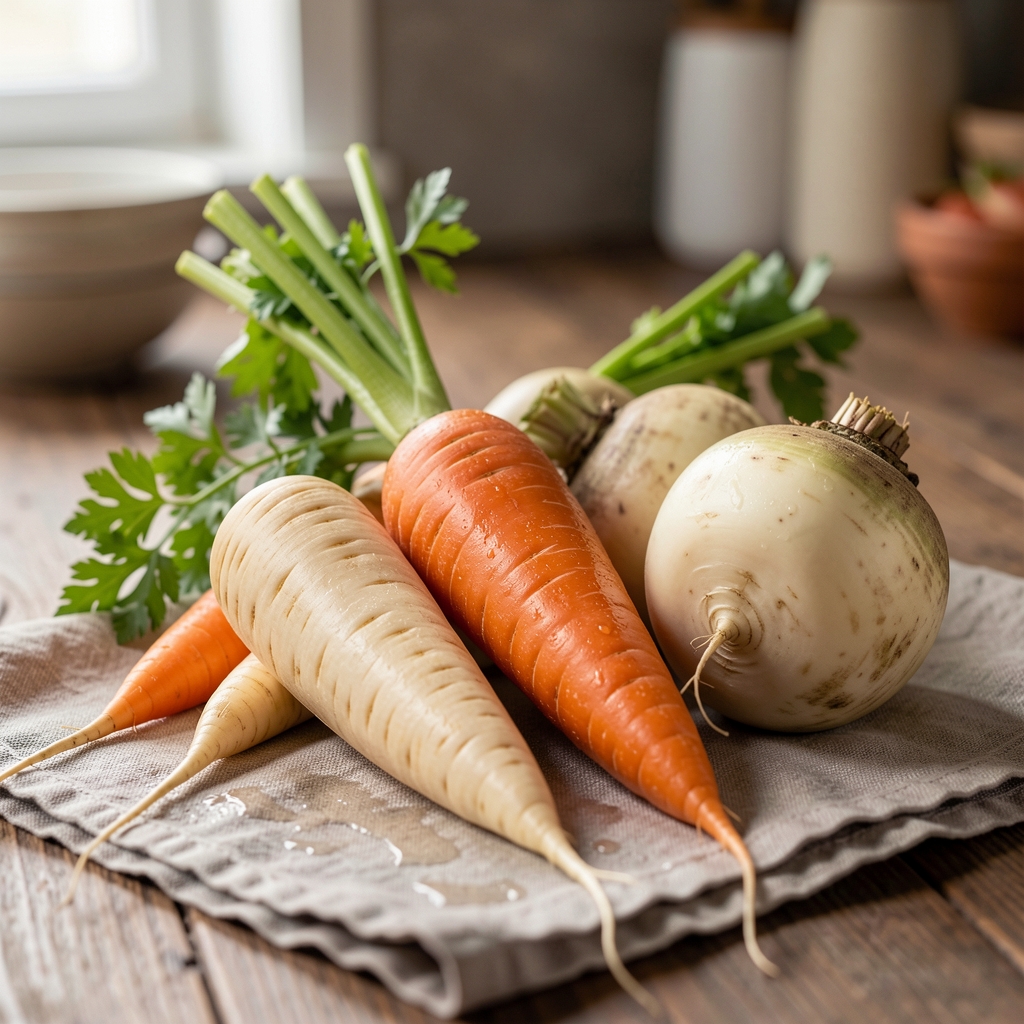
For Caldwell's household, the autumn and winter rotation introduced ingredients that had previously been rare or absent from the weekly shop: kohlrabi, swede, cavolo nero, and dried legumes that served as the structural base for several of the week's main meals. These are not unusual foods. They are, however, foods whose presence in a household tends to be intermittent unless there is some organising logic that makes them a natural choice.
The seasonal calendar, it turns out, provides precisely that logic. When a market stall is dominated by celeriac in October and by asparagus in May, the shopper is offered a ready-made shortlist. The decision fatigue that characterises weekly meal planning — what Caldwell described as "the exhaustion of the open field" — is reduced considerably by a landscape that has already narrowed the options.
"The seasonal rhythm did most of the planning for me. What was in front of me that week became the organising principle."
A common apprehension about ingredient-led seasonal cooking — and one that surfaces periodically in nutritionist guidance circles — is whether a plant-forward, seasonally-determined approach delivers sufficient protein variety and consistent macronutrient balance. The concern is not baseless. A kitchen that is organised entirely around available vegetables can, if not attentive, default to carbohydrate-heavy meals during root vegetable months.
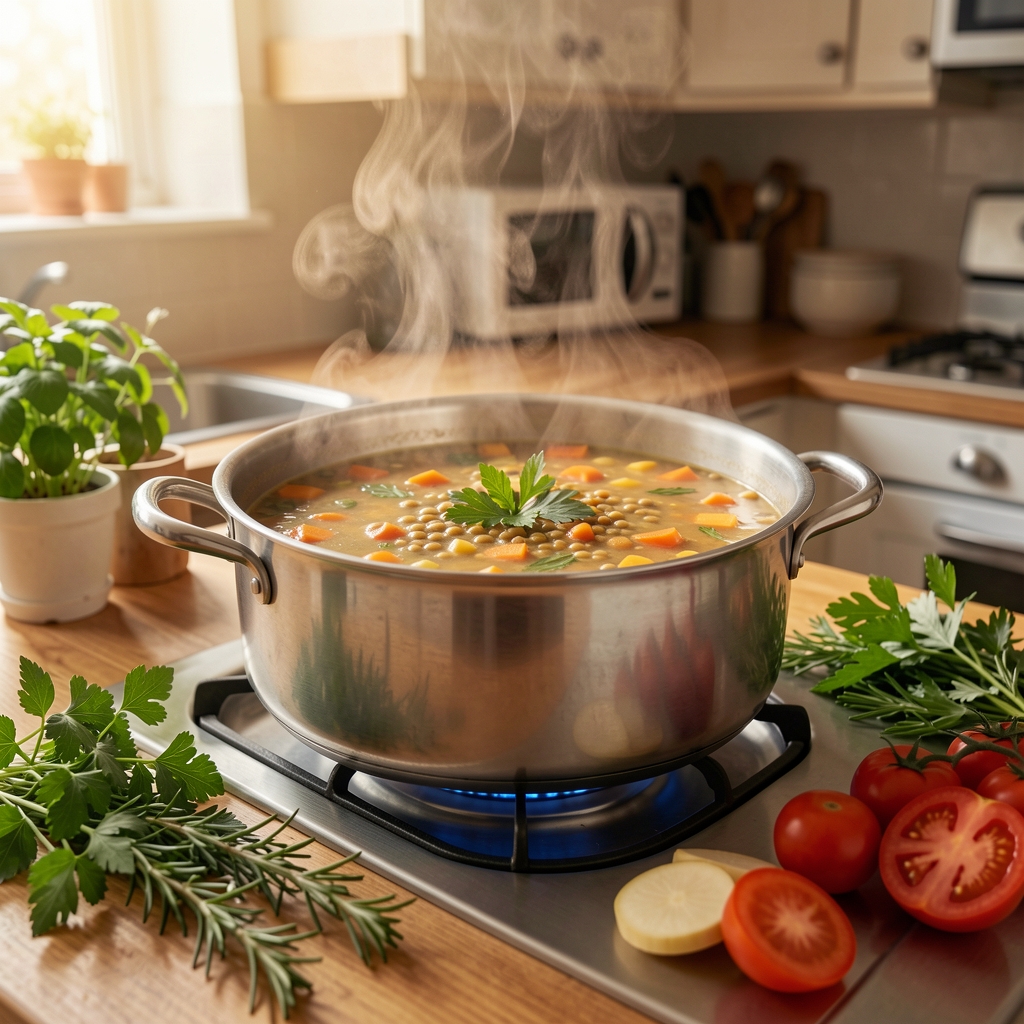
Caldwell navigated this by maintaining a small, fixed pantry of protein anchors: dried lentils, chickpeas, canned sardines, and a rotating selection of fresh fish purchased from a local counter. The vegetable rotation changed weekly. The protein structure remained broadly consistent. This combination — fixed pantry scaffolding plus a variable seasonal produce layer — appeared, across the year of documentation, to support both dietary variety and rough nutritional balance without requiring detailed calorie tracking or portion-by-portion analysis.
The approach broadly aligns with what nutrition writers and practitioners describe as "an anchor-and-vary model": a small set of reliable nutrient-dense staples, around which seasonal variety rotates freely. The model is neither instructive nor rigid. It accommodates travel, limited time, and irregular appetite without collapse.
One of the more quietly interesting recurring observations in Caldwell's documentation concerns attention during meals. She noted, across several entries, that the act of cooking from unfamiliar or less-processed ingredients — a celeriac that required peeling, a dried legume that required soaking the night before — introduced a quality of engagement with the preparation process that had been largely absent from her previous cooking.
This is not an original observation. The relationship between active food preparation and attentiveness during eating has been noted in various forms in published research on eating behaviour. The mechanism appears to be something like this: when a person is more actively involved in making a meal — when the meal has a preparation narrative they can recall — the tendency to eat quickly and without attention is somewhat reduced. The meal carries more context. The context slows the eater.
Caldwell did not embark on a mindful eating programme. She did not set rules about screens at mealtimes or practice any particular eating technique. What she reported, instead, was a gradual natural shift in the quality of attention during meals, which she attributed largely to the changed character of the cooking itself rather than to any deliberate attentiveness practice.
By late autumn, with fermented foods having entered the household through a casual introduction of sauerkraut and kefir, Caldwell began tracking her own digestive patterns — not in a systematic way, but in the observational manner of someone who has noticed a change and is curious about its cause. Her entries over October and November are notable for an absence of the discomfort observations that characterise earlier months.
The connection between seasonal eating, fermented foods, and gut-friendly dietary patterns is well-discussed in nutritional writing. The introduction of diverse plant fibres through a varied seasonal produce rotation is understood to support the kind of microbial diversity that researchers associate with general digestive ease. Fermented foods contribute further through their naturally occurring cultures. Neither observation is individually remarkable. Together, across an undirected year, they produced what Caldwell described as "a kitchen that had somehow become more coherent with my body."
This is the character of long-term dietary change that rarely appears in short-form coverage of nutrition: gradual, cumulative, imprecise, and thoroughly resistant to being summarised in a numbered list. It is the kind of change this almanac exists to document.
Caldwell's documentation was not concerned with weight management as a primary focus. However, across the full year of entries, she noted a gradual reduction in what she described as "the ambient noise of food decisions" — the low-level cognitive load of managing an irregular, recipe-driven kitchen. Portion control, she found, had become less relevant as a conscious practice and more embedded in the structure of the meals themselves. Seasonal cooking, by its nature, tends toward whole ingredients. Whole ingredients, by their nature, are more filling per unit of preparation effort than their processed counterparts.
This is not an assertion about weight management as a assured outcome of seasonal cooking. It is a documented observation from one correspondent over one year. The almanac notes it as such, without extrapolation.

Harriet Caldwell writes on food culture, nourishment habits, and the slow work of domestic cooking. She has contributed to several independent food publications and maintains a personal cooking archive dating to 2019.
More from Indrave Almanac →